
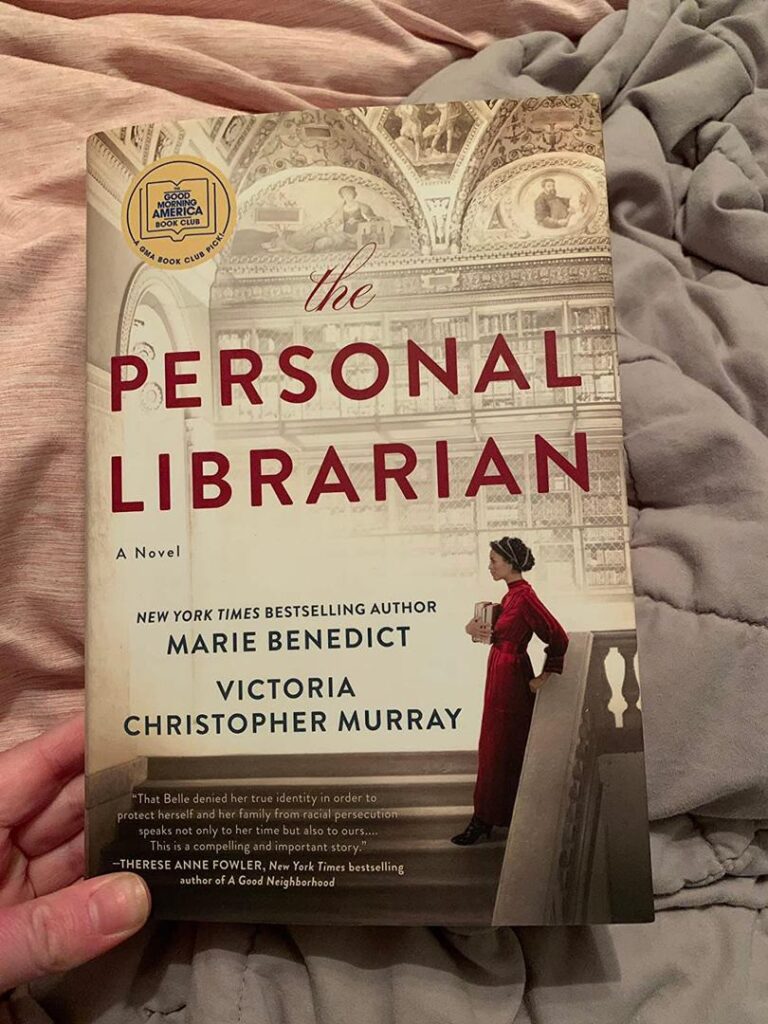
This is the story of a woman who should never have been forgotten in history.
Born Marion Greener, a light-skinned Black woman in early 20th-century America, she reinvented herself as Belle da Costa Greene to pass as white. This was her only way into a world where women—let alone Black women—rarely succeeded. And succeed she did. As J.P. Morgan’s personal librarian, Bella was a woman of unmatched brilliance who built one of the most important private libraries in history, shaping cultural treasures that still endure today.
But The Personal Librarian also tells us about her burden: the weight of secrecy, the constant vigilance required to hide her heritage, the ache of belonging to no place fully. It captures the brilliance of her accomplishments while never letting us forget the cost of survival in a world built on exclusion.
This was not a book I raced through. It was a book I lingered over—sometimes setting it down just to breathe, to let the injustice and courage of her story sink in. And here are some insights I gleaned:
- Brilliance Can Carve Open Closed Doors—But It Can Also Become Armor
Belle’s skill with manuscripts and eye for rare objects forced elite circles to notice her. Her mastery opened rooms that were not meant for her, and in those rooms she remade collections that still matter. But brilliance was double-edged: it was the thing that made her indispensable and the cover she used to survive. The book teaches that our gifts can lift us, yes—but they can also become the mask we hide behind so the world will accept us. - Passing Offers Power, but Steals Peace
Belle’s decision to pass as white allowed her to claim a life that otherwise would have been denied. That power is undeniable. But every negotiation, every handshake, every compliment came with the quiet terror of exposure. The safety of passing demanded constant performance: a life lived in small silences, in tiny erasures. The lesson is brutal and simple—strategies that keep us alive can also fragment the soul. Freedom bought at the price of truth is still captivity. - Power Without Freedom Is a Golden Cage
From behind Morgan’s doors Belle shaped taste, culture, and legacy. She wielded remarkable influence in a man’s world. And yet her influence did not equal wholeness. She could commission a masterpiece but could not commission a life in which she could be fully herself. The book makes you sit with that paradox: prestige and visibility do not automatically translate to liberty. You can be powerful and still be profoundly constrained. - Secrets Do Not Stay Silent Forever
Belle’s concealment didn’t begin with her—it was braided into family history, choices made by parents and ancestors who thought concealment a survival tactic. The quiet she carried rippled through siblings, relationships, and later generations. The memoir shows how private decisions become public legacies: the unspoken shapes us, and the burden of secrecy echoes long after the original secret was formed. This is not just Belle’s story; it’s a caution about inheritance—what we hide often becomes what our children inherit. - To Ache for Wholeness Is the Deepest Human Longing
Under the accolades and acquisitions was a yearning so basic it hums in the bones: to be seen whole. Belle built a public life of staggering achievement, yet her victories were threaded through with loneliness. The book reveals that success, without the possibility of being fully seen, leaves an ache that nothing else can fill. The deepest lesson: wholeness—not applause—is the truest freedom we seek.
For me, this book is a reclamation of a woman’s story—a woman whose light was partially hidden behind the shadows of powerful men and the prejudices of her time. Belle da Costa Greene was extraordinary, not because she passed, but because she dared to build, to rise, and to thrive in a world designed to diminish her.
This book is not a fast-paced escape. It is meant to be read slowly, like holding a rare manuscript in your hands, each page reminding you of the weight it carries. I didn’t want to put it down. More than that, I didn’t want to let Belle go.
It is educational, yes. Inspirational, yes. But above all, it is haunting. If you’ve ever felt unseen, if you’ve ever been forced to hide who you are just to belong, Belle’s story will reach into you. And maybe, it will give you the courage to stop hiding and to step into the fullness of your truth.
High-quality information presented in a very digestible way.
This website has become my shortcut.
Glad to make it to your list