
“To live fully is to be always in no-man’s-land, to experience each moment as completely new and fresh. To live is to be willing to die over and over again.” – Pema Chödrön
Her name, before everything changed, was Deirdre Blomfield-Brown.
She had done everything correctly. Attended the right schools – Miss Porter’s, then Berkeley. Married young. Moved to New Mexico. Became an elementary school teacher. Had two children. Built the kind of life that, from the outside, looked entirely coherent. Entirely safe. Entirely complete.
And then one ordinary day in 1972, her husband sat down and told her he was having an affair. That he wanted a divorce. And the ground – the ground she had spent thirty-six years carefully, methodically constructing beneath her feet – simply disappeared.
“I couldn’t feel any ground under my feet,” she said, years later. “It was devastating. I was scared and I was angry and I couldn’t get anything to come back together.”
She tried everything. Therapy. An ashram. Weekend intensives in Scientology. None of it touched the thing that had broken open inside her. She spent a year in what she would later describe simply as groundlessness; that particular, vertiginous terror of a life that no longer has a floor.
And then, riding in a friend’s pickup truck, she glanced at a magazine lying open on the seat. An article by a Tibetan Buddhist teacher named Chögyam Trungpa. The title: Working with Negativity. The first line: There’s nothing wrong with negativity.
She took this to mean: there’s nothing wrong with what you’re going through. It’s very real, and it brings you closer to the truth. She said it was the first sane thing anyone had said to her since her life fell apart.
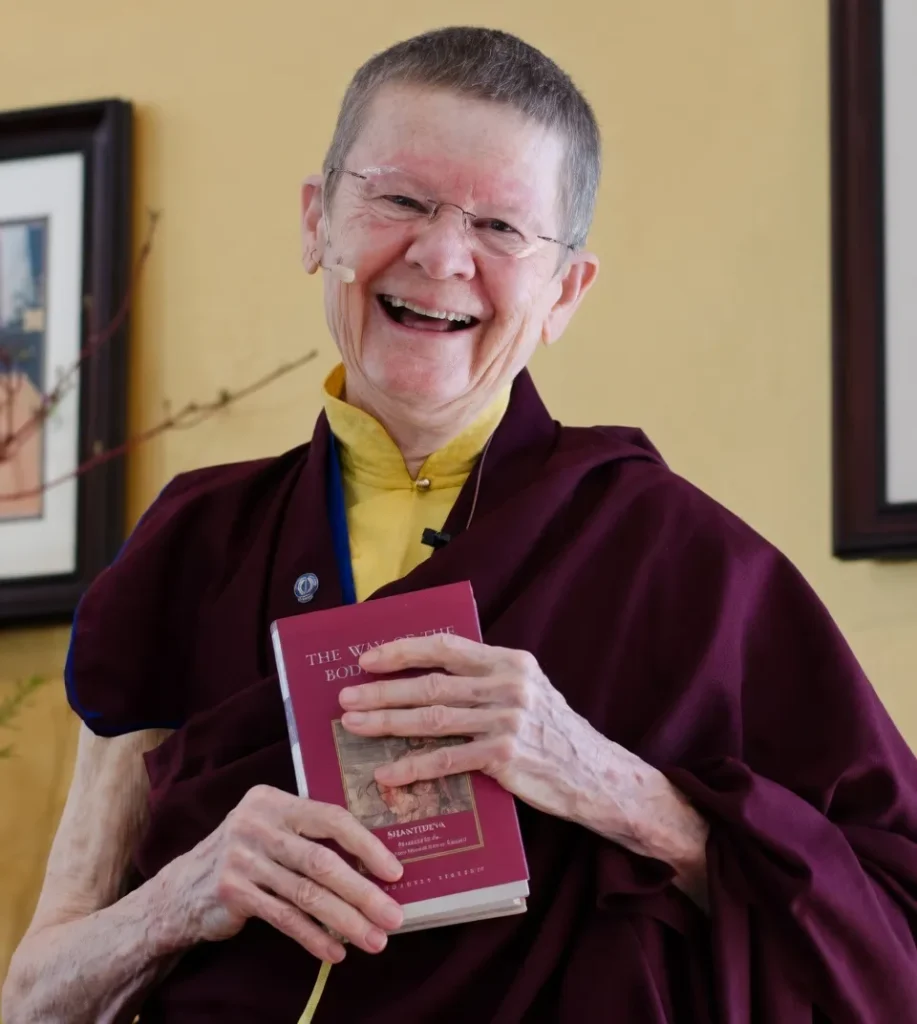
Four years later, Deirdre Blomfield-Brown had taken Trungpa as her teacher and become an ordained Buddhist nun. She took the name Pema Chödrön. In 1984, she moved to a remote monastery on the coast of Cape Breton, Nova Scotia, the first Tibetan Buddhist monastery in North America established for Westerners, and became its spiritual director. She has been there ever since. Teaching. Writing. Sitting with her own groundlessness and, in doing so, learning how to sit with everyone else’s.
When Things Fall Apart was published in 1996. It has never gone out of print. It has been translated into dozens of languages, sold millions of copies, and has a habit of arriving in people’s lives at precisely the moment they most need it; slipped into a bag by a friend who didn’t know what else to say, found in a hospital waiting room, pulled from a shelf during the worst year of someone’s life. It is one of the most quietly radical books of the twentieth century. And it contains an idea so counterintuitive, so contrary to everything Western culture tells us about pain, that it takes most people multiple readings to fully absorb it.
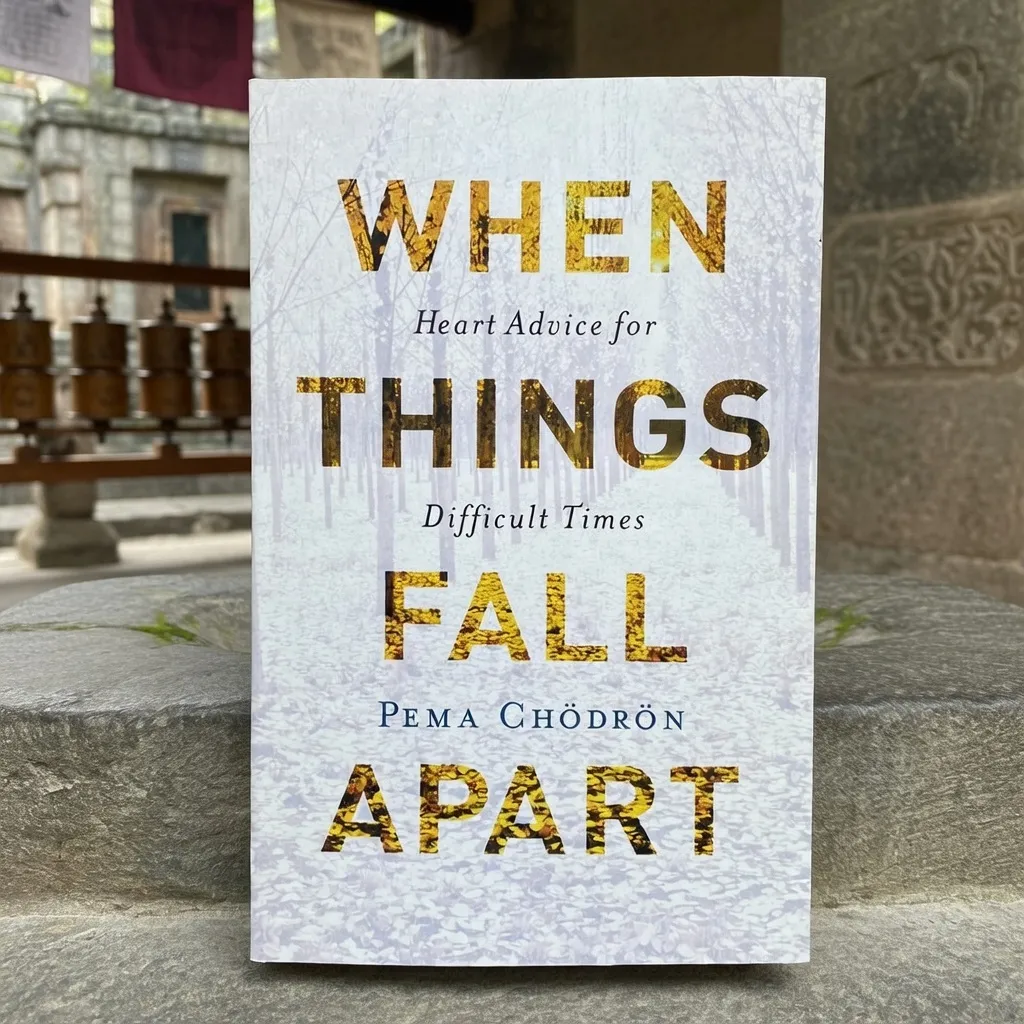
The idea is this:
I. The Ground Was Always an Illusion
We spend our lives in pursuit of solid ground; a stable relationship, a coherent identity, the reassuring sense that we know what tomorrow will bring. And when the ground disappears, as it always eventually does, we experience it as catastrophe. As failure. But Chödrön says something that takes the breath away in its simplicity: the shakiness, the groundlessness, the in-between state – this is not a problem to be solved. It is the actual nature of existence, finally making itself known. The ground was always an illusion. We constructed it carefully, maintained it furiously, and called it reality. The moment it dissolves in a diagnosis, a divorce, a loss so complete it renders all your previous certainties meaningless, but we are not falling. We are, for the first time, feeling the truth of things.
II. Fear Is Not Your Enemy
Chödrön parts sharply here from everything the self-help industry tells us about difficult emotions. She does not want you to manage your fear, reframe it, or breathe it away. She wants you to get close to it; uncomfortably, intimately, unflinchingly close. Fear, she writes, is not weakness. It is a natural reaction to moving closer to the truth. The moment you feel it most acutely – when every instinct screams at you to look away, to numb out, to do anything but stay – that is the moment you are nearest to something real. Something that, if you can bear to stay with it rather than flee, will teach you something no comfortable life ever could.
III. Hope – Desperate, Clinging Hope – Is Part of the Problem
This is the teaching that most unsettles people, myself included. I argued with it, rejected, came back to, and eventually – reluctantly – began to understand. Chödrön asks us to give up hope. Not optimism. Not agency. But the hope that is fundamentally a refusal; a refusal to accept that pain is real, that loss is permanent, that things will not always resolve the way we need them to. “If we’re willing to give up hope that insecurity and pain can be exterminated,” she writes, “then we can have the courage to relax with the groundlessness of our situation.” What she offers instead is not despair. It is presence; the willingness to inhabit your actual life, rather than the imagined future life where everything has finally been fixed.
IV. Your Suffering Is the Door to Everyone Else
This is perhaps the most unexpected teaching in the book and the most beautiful. Chödrön teaches a practice called tonglen: you breathe in the pain of the world, and breathe out relief. It sounds almost perverse. We spend our lives trying to breathe the pain out. Tonglen reverses the entire logic. You sit with your own grief and think: there are millions of people feeling exactly this right now. And you breathe it in for all of them. And breathe out space, and warmth, and the wish for relief. We are not alone in bumping again and again against the unbearability of things. Which helps us bear it. It is an extraordinary practice because it breaks the terrible loneliness of pain.
V. This Moment – However Terrible – Is the Whole Classroom
The final teaching is the oldest. The river running beneath all the other rivers. This very moment is the perfect teacher, and it is always with us. Not the moment after this one. Not the moment when the grief has lifted or the diagnosis has changed. This one; the one you are in right now, which might be, by every external measure, the worst one you have ever occupied. That moment, Chödrön insists, is not an obstacle to awakening. It is awakening. It was always the whole thing. We just didn’t know how to look at it.
I have read When Things Fall Apart three times. Each reading has been a different book because each reading has found me in a different kind of falling apart, needing a different door into the same dark room.
Look, what Pema has achieved here is rarer than it sounds: a book about suffering that does not flinch from suffering’s reality, that does not offer the consolation of a tidy resolution, that does not promise you the ground will come back. Instead, it offers company in the groundlessness.
Be kinder to yourself, she says. And then let your kindness flood the world.
It sounds simple. It is the work of a lifetime. And this book is, for my money, one of the most reliable companions available for that work.
Keep it close. You will need it. And when the ground disappears as it will, as it does for all of us, open it anywhere. She will be there.
She has always been there.