
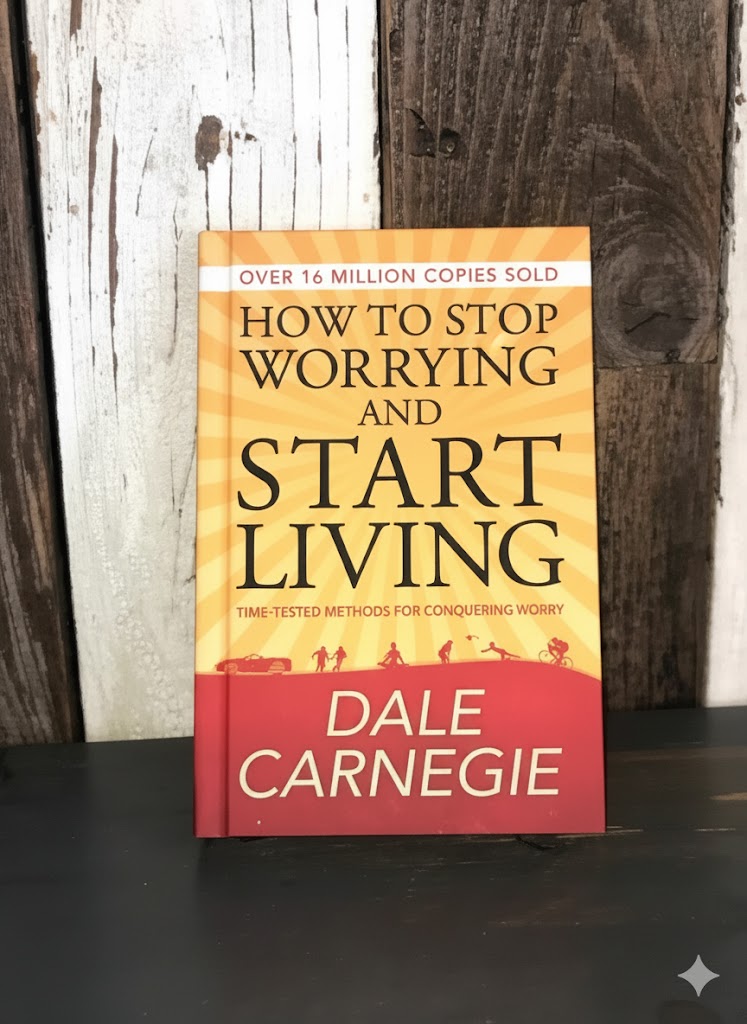
The title answered the curiosity that lays between almost all of us. Not the loud, dramatic kind of worry that announces itself and demands attention, but the low hum kind. The worry that sits with you over breakfast. That follows you into conversations you are supposed to be present for. That wakes up slightly before you do. Dale Carnegie wrote this book in 1948 and somehow it reads like it was written last Tuesday, which tells you something important about how long human beings have been losing sleep over things that have not happened yet. Carnegie, who is perhaps best known for How to Win Friends and Influence People, one of the best selling books in history and a quiet revolution in how people think about human relationships, brought that same practical warmth to this one. Less about impressing the world. More about surviving your own mind.
What Carnegie understood, and what makes this book hold up across decades, is that worry is not primarily an intellectual problem. It is a habit. And like all habits it can, with the right tools and the right honesty about what you are actually doing, be interrupted and eventually replaced. He does not promise the absence of difficulty. He promises something more realistic and more useful: a way of meeting difficulty without being flattened by it. That is a different offer from most books on the subject, and it is a better one.
The book draws heavily on real stories, ordinary people who found themselves crushed under the weight of anxiety and found ways, sometimes simple and sometimes hard won, to climb back out. Carnegie believed in the wisdom of lived experience over theory, and it shows. Reading it feels less like a lecture and more like sitting in a room full of people who have been where you are and came back to say something about it.
Three lessons worth carrying
1. Live in day tight compartments. This is Carnegie’s most famous and most practical instruction, borrowed from the physician William Osler, and it has lost none of its force. The idea is simple: the past cannot be changed and the future has not arrived, which means the only place where life can actually be lived is today. Not as a philosophy to believe in but as a daily practice to return to. In real terms this means the person lying awake at 2am rehearsing a conversation from three weeks ago, or catastrophising about a year that has not begun, is spending real energy on events that exist only in their head. Bringing attention back to the present day, repeatedly and without self judgement, is not a small thing. It is, Carnegie argues, the whole thing.
2. Ask yourself what the worst that could actually happen is, then accept it. Carnegie’s formula for breaking the grip of worry is disarmingly direct. Name the worst possible outcome. Accept it fully. Then calmly work to improve on it. Most people never get to the first step. They circle the fear without landing on it, which keeps it large and shapeless and powerful. When you actually sit down and look at the worst case clearly, two things tend to happen. First, it is usually more survivable than the circling suggested. Second, once you have accepted it, it stops holding you hostage. The worry loses its leverage because you have already looked it in the face.
3. Keeping busy is not avoidance. Sometimes it is medicine. Carnegie makes a case, grounded in both psychology and plain observation, that one of the most effective ways to interrupt anxious thinking is purposeful action. Not distraction for its own sake, but genuine engagement with something that requires your hands or your mind or both. In everyday life this looks like the person who cleans the kitchen not because it needs cleaning but because moving through a task returns them to themselves. Worry, Carnegie notes, struggles to survive in a mind that is genuinely occupied. This is not a cure. But it is a tool, and an honest one.
Carnegie never claimed to have solved worry. He was too wise and too human for that kind of promise. What he offered instead was a set of practices worn smooth by actual use, tested by real people in real difficulty, and passed forward in the hope that the next person in the dark might find them useful. Decades later, they still are.