
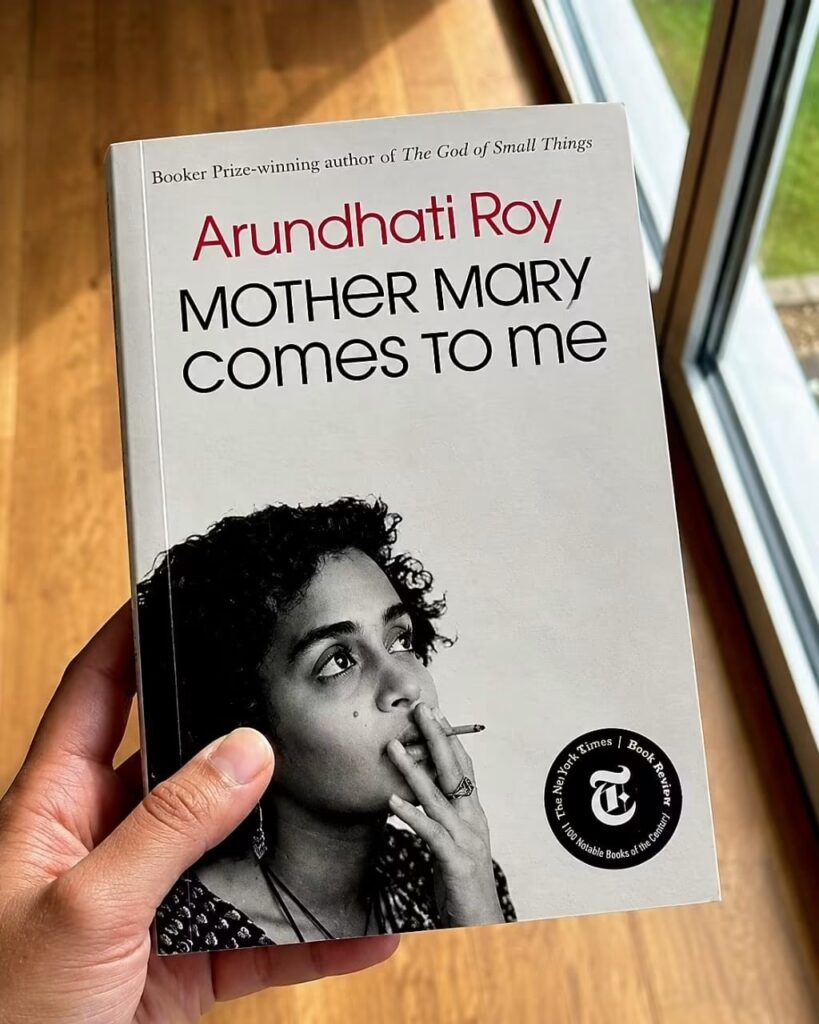
At eighteen, Arundhati Roy left her mother’s house and kept her distance for years. She became an architect, a screenwriter, then the author of “The God of Small Things”, which won the 1997 Booker Prize and changed what Indian fiction in English could be.
Then she turned away from fiction. For two decades she wrote essays against dams, nuclear nationalism, corporate land grabs and the Indian state. She became one of the most quoted dissenters of her time.
In 2022 Mary Roy died, and her daughter, who had faced down governments, found herself undone. “Mother Mary Comes to Me” is what came out of that grief. It is not a eulogy and it is not a hit job. It is Roy’s attempt to look straight at the woman she calls “my shelter and my storm” and to accept that both are true.
Mary Roy is an extraordinary subject. She left a failing marriage with two small children and went back to a Kerala that had little room for a divorced woman. She built a school from almost nothing. She then took her own community to court and won a landmark 1986 Supreme Court ruling that gave Syrian Christian women equal inheritance rights. She could be generous and visionary in public and frightening at home. Roy writes about both sides without softening either one, and that refusal gives the book its charge.
Five things that stay with you:
1. Leaving is not the same as getting free.
Roy left at eighteen, but the book shows how little that settled. Her mother’s defiance, her contempt for convention and her appetite for a fight all show up in the daughter’s life and work. You can put a thousand miles between yourself and the person who made you, and still find her in your own voice.
2. Freedom can be learned from someone who denied you some of it.
Mary Roy fought publicly for women’s independence while running her household with a hard, controlling hand. Arundhati learned what freedom looks like by watching her mother claim it, and she learned what its absence feels like by living under her. The book holds both lessons without pretending one cancels the other.
3. Seeing someone clearly is a form of love.
Roy does not explain her mother away. She doesn’t diagnose her, excuse her or resolve her. She simply refuses to look away from any part of her. The book argues, without saying so, that this kind of sustained attention may be the most honest love there is.
4. Grief for a difficult parent is its own kind of grief.
Roy describes herself as “heart-smashed,” and the phrase fits. Mourning someone who hurt you is not simpler than mourning someone who didn’t. It can be harder, because the relationship ends without being finished. Roy offers no closure, and the book is more truthful for it.
5. Writing is how Roy thinks.
She has always written to understand power. Here she points that same scrutiny at the most intimate power of all, a mother’s power over a child. In doing so she ends up explaining herself too: where her fearlessness came from, and what it cost.
Mother Mary Comes to Me is Roy’s most personal book. It may also be her best since “The God of Small Things”, and readers of that novel will recognize the source of Ammu, its unforgettable, unbending mother.
Read it if you have ever loved someone you couldn’t quite forgive.
Read it if you have lost a parent and found the grief more tangled than you expected. And read it if you want to see a writer who has spent her life taking on the powerful turn, finally, to the person who taught her how.