
When my brother died, people sent sympathy cards to his wife. They sent casseroles to his kids. They called my parents every evening for weeks. At the funeral, a long line of mourners hugged his widow, held my mother’s hands, and patted my father on the back.
Then they reached me, and said, “How are your parents holding up?”
I understood. I did. But I had just lost the person who had known me longer than anyone else on earth. The boy who taught me to ride a bike and blamed me for the broken lamp. The man who could make me laugh with one look across a Thanksgiving table. We had shared a childhood, a bedroom, a whole private language. And it felt like no one thought I had the right to be shattered.
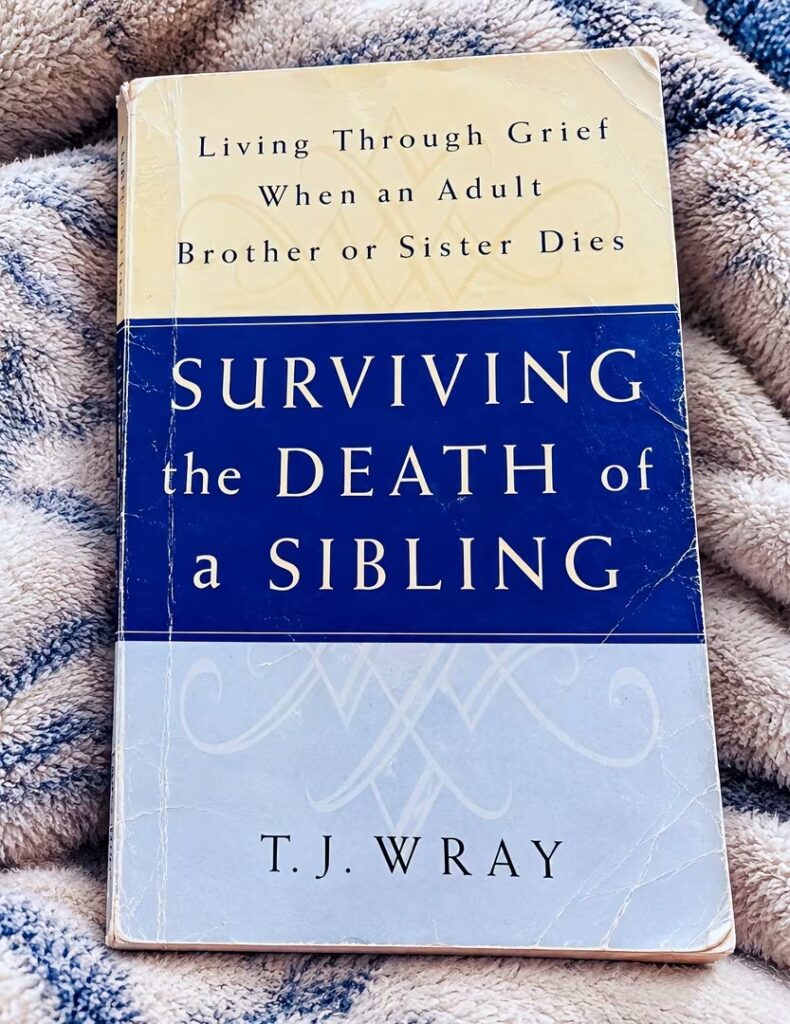
T.J. Wray knows that feeling. When her own brother died, she discovered how invisible adult siblings become in grief, and she wrote “Surviving the Death of a Sibling” for the “forgotten mourners.” It’s gentle, practical and deeply validating, the book I wish someone had handed me the week of the funeral.
1. Your grief is real, even if others don’t see it
Society has clear scripts for widows, widowers and grieving parents. Adult siblings are often left out of the story entirely. Wray names this so plainly that I cried with relief. Losing a brother or sister in adulthood is a profound loss, and you’re allowed to grieve it as deeply as anyone else.
2. You’ve lost your past and your future
A sibling is the only person who remembers your childhood the way you do. They’re also the person you expected to grow old beside, to share the care of aging parents with, to call when no one else would understand. Wray helps you see that sibling loss is a double grief: the shared history that’s gone, and the future you’d quietly counted on.
3. Old rivalries and unfinished business can haunt you
Sibling relationships are complicated. There may have been jealousy, distance, arguments never resolved. Wray addresses the guilt and regret that so often follow, and gently guides you toward making peace with what can no longer be said face to face.
4. Your place in the family shifts
When a sibling dies, the whole family structure changes. You may suddenly become the oldest, the only child, the caregiver for your parents, the one everyone leans on. Wray helps you recognize these new, often unspoken roles, and gives you permission to grieve while you carry them.
5. Healing is possible, and the bond continues
Wray never rushes you toward “closure.” Instead, she offers practical ways to work through grief: talking about your sibling, writing, honoring their memory, finding support. Over time, she shows, the pain changes shape. And the love between you, that lifelong, complicated, irreplaceable love, never actually ends.
My brother’s birthday was last week. I made his favorite pie, the lopsided cherry one he always insisted was better than Mom’s, and ate a slice standing in the kitchen. I told him, out loud, that I missed him.
For the first time, I didn’t feel silly doing it.