
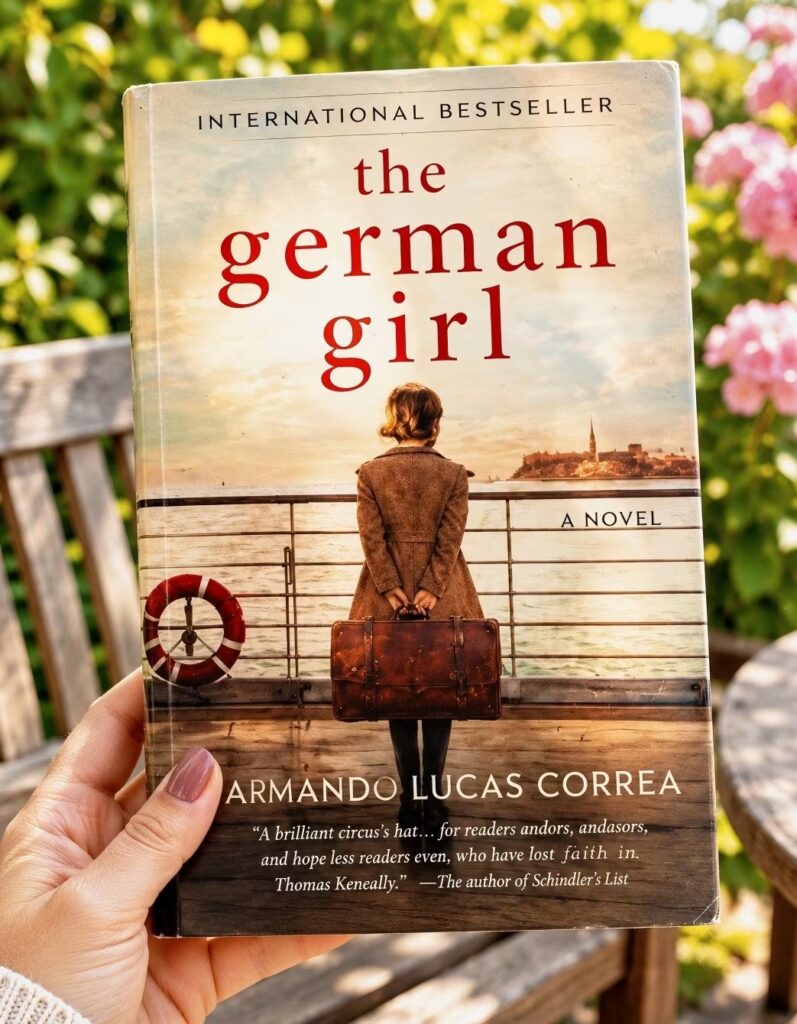
Imagine standing on the deck of a ship, close enough to see the lights of the city where your new life is supposed to begin.
You can hear music drifting across the harbor. You can see people walking along the waterfront. Your family sold everything to get here. You escaped the Nazis with your lives. Freedom is less than a mile away.
And no one will let you off the boat.
That really happened. In May 1939, more than nine hundred Jewish refugees sailed from Germany to Cuba aboard the St. Louis. When they reached Havana, they were refused. So was the United States. So was Canada. The ship was forced to sail back to Europe, and many of those passengers later died in the Holocaust.
“The German Girl” puts you on that deck.
Hannah Rosenthal is twelve, clever, a little spoiled, and fiercely loyal to her best friend Leo. She grew up in a grand Berlin apartment, surrounded by beautiful things. Then, almost overnight, her family becomes the enemy. Neighbors look away. Doors close. Her parents start whispering behind locked doors, and Hannah learns what fear tastes like.
So when her family gets tickets on the St. Louis, it feels like a miracle. Hannah and Leo make a solemn promise to stay together no matter what. On board, there are elegant dinners, dancing, sunshine on the open sea. For two weeks, they almost feel like children again.
You’ll want to warn them. You’ll want to reach into the pages and tell them to hold each other tighter, because you know what’s waiting at the end of that voyage. And you can’t stop reading, because you have to know who survives it.
Seventy-five years later, an eleven-year-old girl in New York named Anna is searching for a father she never met. He died on September 11th before she was born. When a mysterious package arrives from a great-aunt in Cuba, Anna and her mother fly to Havana, and walk straight into a family secret that has waited three generations to be told.
Two girls. Two broken worlds. One story that stretches across decades to find its ending.
Armando Lucas Correa, who was born in Cuba, writes with such tenderness that Hannah stops feeling like a character and starts feeling like a child you know. I cried on a park bench reading one scene and didn’t care who saw.
But here’s what stays with you most: those nine hundred people were real. They had names, birthdays, favorite songs, best friends. They waved at a harbor that wouldn’t let them in, and the world turned its back.
This book gives them back their faces.
Read it. Then go look at the photographs of the real St. Louis, those families crowded along the railings, still hoping. You won’t be able to look away.
And neither should we have, back then.