
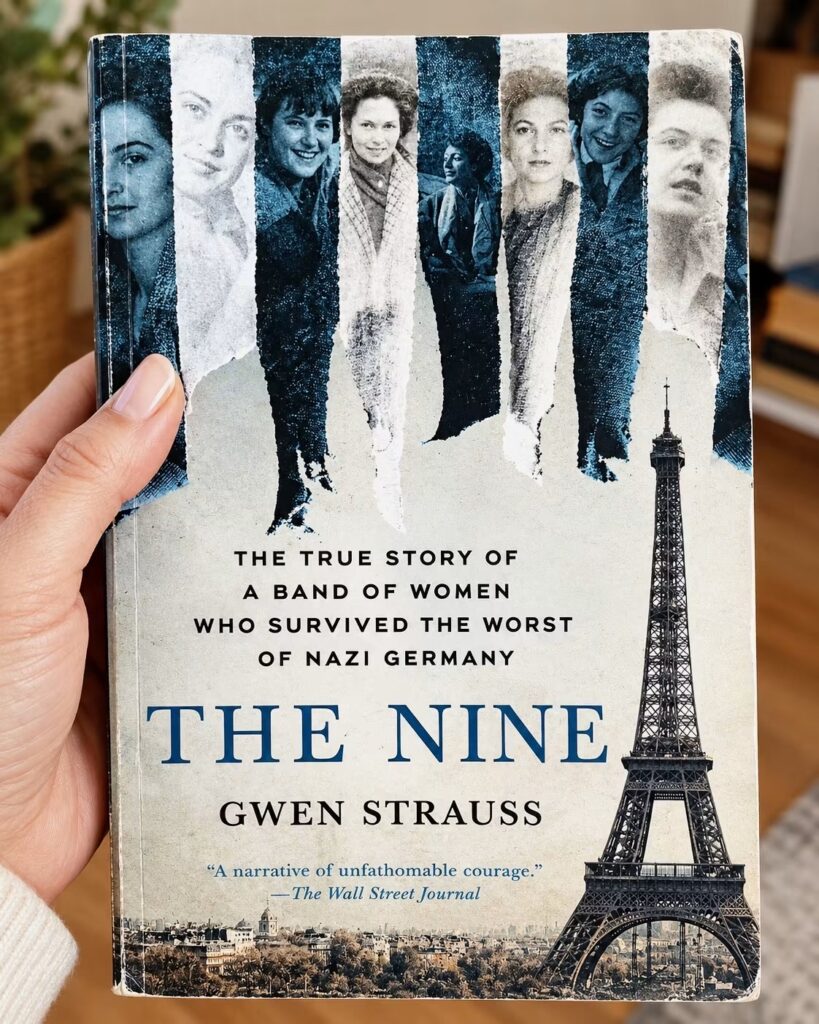
April 1945. A column of starving women is being marched out of a labour camp in Leipzig, along roads lined with soldiers who have orders to shoot anyone who falls behind. The war is almost over. These women are not supposed to live to see the end of it.
Somewhere in that column, nine of them catch each other’s eyes.
We’ll come back to that moment. Because the truth is, we very nearly never got there.
A few months ago, the paperback of Gwen Strauss’s “The Nine” was passed around our little circle of readers. Everyone had heard it was extraordinary. And one by one, each of us quietly gave up on it. Not because it was dull. Because of the names. Hélène, Zaza, Zinka, Lon, Guigui, Mena, Jacky, Nicole, Josée. Nine women, most of them known by Resistance nicknames, French and Dutch, weaving in and out of each other’s stories. You’d be three pages into a harrowing scene and realise you had no idea which woman it was happening to. Flip back. Lose the thread. Put it down “for now.” For now became weeks.
Then one of us tried the audiobook on a long drive, and called the rest of us that same evening. “You have to listen to this. Forget the paperback. Just listen.”
She was right.
Juliet Stevenson reads it, and within the first hour something remarkable happens. The names stop being a list and start being people. Zaza has a voice. Lon has a voice. Hélène, the quiet one everyone looks to, has a voice you’d follow anywhere. We stopped trying to remember who was who because we simply knew them, the way you know friends. And once you know them, you are in trouble, because now you care what happens to them.
And so much happens to them.
They are young, most in their early twenties, some barely out of their teens, when they are arrested for working with the Resistance. They survive interrogation. They survive Ravensbrück. They are shipped to Leipzig and forced to make munitions for the regime that is starving them to death. Through all of it, nine strangers become something closer than sisters. They share crumbs. They hold each other upright at roll call. They make promises.
Which brings us back to that column on the road.
I won’t tell you how they do it. I won’t tell you who stumbles, or what they find in the farmhouses and ditches of a collapsing Germany, or who they have to talk their way past, or how close they come, more than once, to losing everything ten steps from freedom. I’ll only tell you that for ten days we carried them with us. In the car. In the kitchen. Lying awake at night, earbuds still in, unable to stop at the end of a chapter because we needed to know they were still together.
And the ending. Stay for the very last minutes of the recording. I’m not going to say why. Just stay.
And personally, what makes this book generational isn’t only the escape. It’s that Gwen Strauss is Hélène’s great-niece, and she spent years chasing these women’s stories down before they disappeared forever. These nine never asked to be heroes and most of them never spoke of what they’d survived. If she hadn’t written it, the world might never have known. And if we hadn’t pressed play, we’d never have known either.
So if you’ve got “The Nine” sitting half-read on your shelf, or if you’ve never heard of it at all, do yourself a favour. Don’t read it. Listen to it. Let nine extraordinary women walk you home.