
I bought Theo of Golden because one of my friends wouldn’t stop talking about it. She wasn’t recommending it exactly; that would have been easier to ignore. She just kept circling back to a character named Theo who’d made her reconsider what kindness actually costs. About how a book with almost no plot had somehow become one of the most important things she’d read all year.
It’s now three weeks since I finished this book, and “I’m her.” I am the person who can’t stop talking about Theo. Who’s been trying to figure out how Allen Levi wrote a book where almost nothing happens and yet everything shifts.My reflection on Allen Levi’s book and the transformative power of being truly seen.
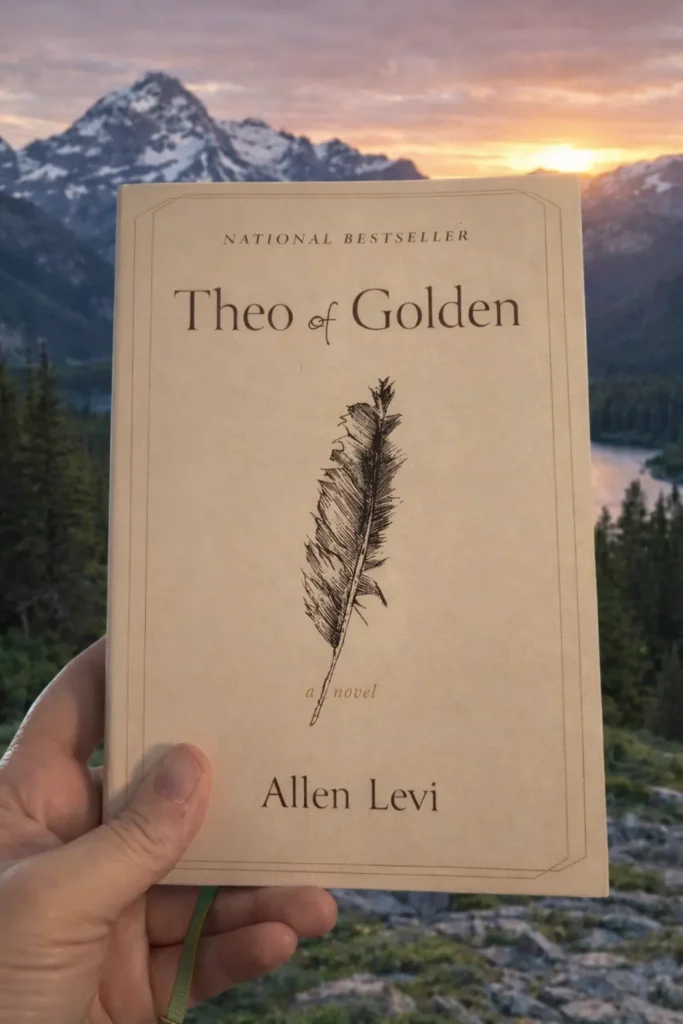
A Man, A Town, Ninety-Two Portraits
One spring morning, an old man named Theo arrives in Golden, Georgia. A small southern town. The kind with one stoplight and everybody knowing everybody else’s business except when they’re pretending not to. Nobody knows where he came from. Nobody knows why he’s here. He’s Portuguese. In his eighties. Soft-spoken. Asks more questions than he answers.
He walks into a coffee shop named The Chalice and sees something that changes everything: ninety-two pencil portraits hanging on the walls. Not professional art. Just drawings. Faces. People from Golden, sketched by a local artist called Asher who’d sat in that coffee shop for years, quietly capturing anyone who’d allow.
And Theo, for reasons he won’t explain, decides to buy them. All of them. One at a time. And return each portrait to the person it depicts. Their “rightful owner,” he calls it. That’s the whole plot. That’s it. An old man buying drawings and giving them to people.
But here’s what Levi articulates cleanly: being truly seen is a kind of violence. It cracks you open and makes you realize how long you’ve been invisible, even to yourself.
What It Means to Be Returned to Yourself
When Theo shows up at your door holding a portrait of your face, drawn years ago by someone who saw you clearly, it’s not just receiving art. It’s being told: You exist. You matter. Someone noticed you enough to capture you. And now someone else cares enough to make sure you know.
Each portrait comes with a story. And Theo is interested in the stories; he sits down. Asks questions. Listens in a way that makes people tell him things they’ve never told anyone. About loss. About regret. About the person they used to be before life bent them into shapes they didn’t recognize.
One woman gets her portrait and realizes she’s been hiding since her husband died. Another man sees himself as he was before grief made him unrecognizable. A teenager discovers that someone saw her when she thought she was invisible.
And Theo, this mysterious old man who won’t talk about himself, becomes the catalyst for Golden waking up to itself. For people remembering they’re more than their routines. More than their wounds. More than the diminished versions of themselves they’ve been performing for years.
The Mystery That Accumulates Like Snow
Who is Theo, really? Why Golden? Why these portraits? Why now?
Levi lets the questions accumulate like snow, beautiful and heavy, until we’re leaning into the story, desperate to understand. We catch glimpses of Theo’s past; fragments about Portugal, about a life lived in many places, about success and connections that span continents. But also: sadness. Pain. Something that brought him here, to this unremarkable Southern town, on a mission that seems both random and deeply intentional.
The book moves like a river; quiet stretches where we’re just living alongside these characters, then sudden depths that pull us under. Theo’s conversations feel effortless, but they’re doing something profound. He redirects attention away from himself with such skill that we almost don’t notice we’re learning more about everyone else than we are about him.
Until the end, which doesn’t just conclude the story; it reframes it completely. Reshapes everything you thought you understood about why Theo came, and what the portraits were really for. I finished the last page and immediately wanted to return to the first.
The Book That Refuses to Rush
I’m going to be honest with you: some readers may dislike this book. It is slow. Deliberately so. There’s no villain. No crisis. No plot twist that changes everything. Just an old man moving through a town, having conversations, returning portraits, being present in a way that feels almost radical in its simplicity. If you’re someone who needs constant momentum, who measures a book’s worth by how fast it moves and the suspense, you’ll find this book interminable. Plotless. Self-indulgent.
But if you’re willing to slow down, if you can let the book set its own pace instead of demanding it match yours, something shifts. You stop waiting for the big reveal. Stop needing to know Theo’s secret. Stop caring about plot. You just… sit with it. The way you’d sit with a friend who is comfortable with you being yourself, just being there.
The Questions It Made Me Ask:
When’s the last time I really saw someone? When’s the last time I paid attention to someone’s story instead of waiting for my turn to talk? And harder still: When’s the last time I let myself be seen? Really seen, not performing competence or hiding behind accomplishments, just… existing as I am, without armor.
What Levi understands and articulates so gently is that most of us are walking around with portraits of ourselves hanging somewhere. Drawn by someone who noticed us at a moment when we were fully present, before we learned to edit and minimize and disappear. And we never got them back. We never got told: this is you, as you were, as someone saw you.
Theo is a man who gives that back. One face at a time, in one small town, with no announcement and no agenda. Just attention and a quiet insistence that people are worth being seen.
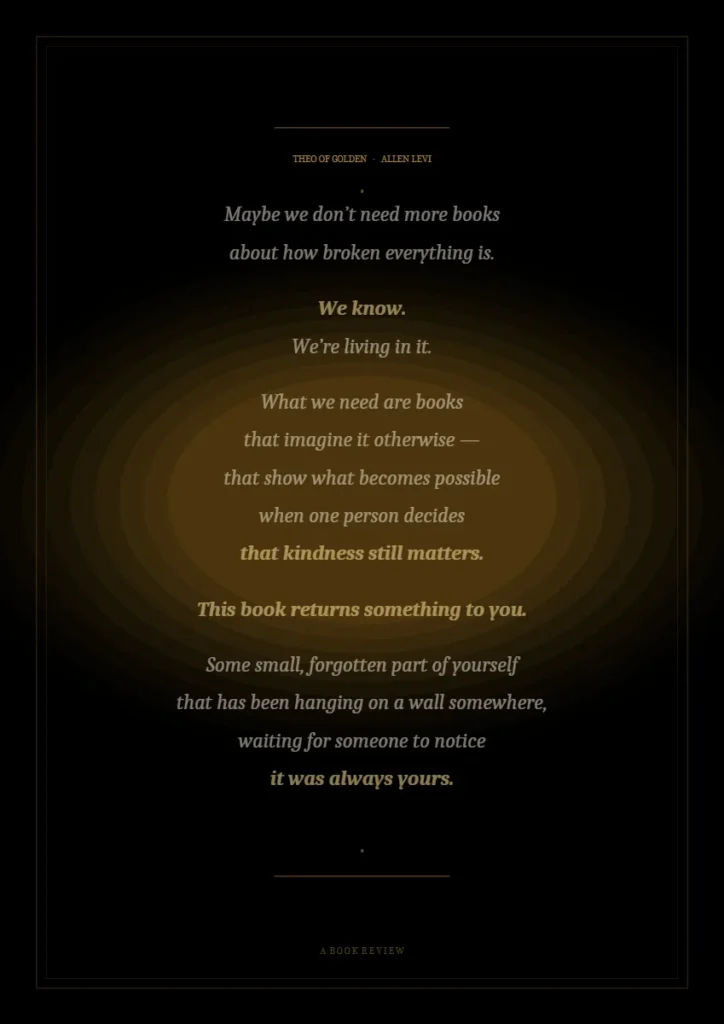
Theo of Golden began as a self-published novel, passed quietly from hand to hand. Word spread quietly, person to person, the way secrets travel when they’re too good to keep. It is now a New York Times bestseller.
If you read it, you’ll understand exactly why.
I’ll leave the light on for you!