
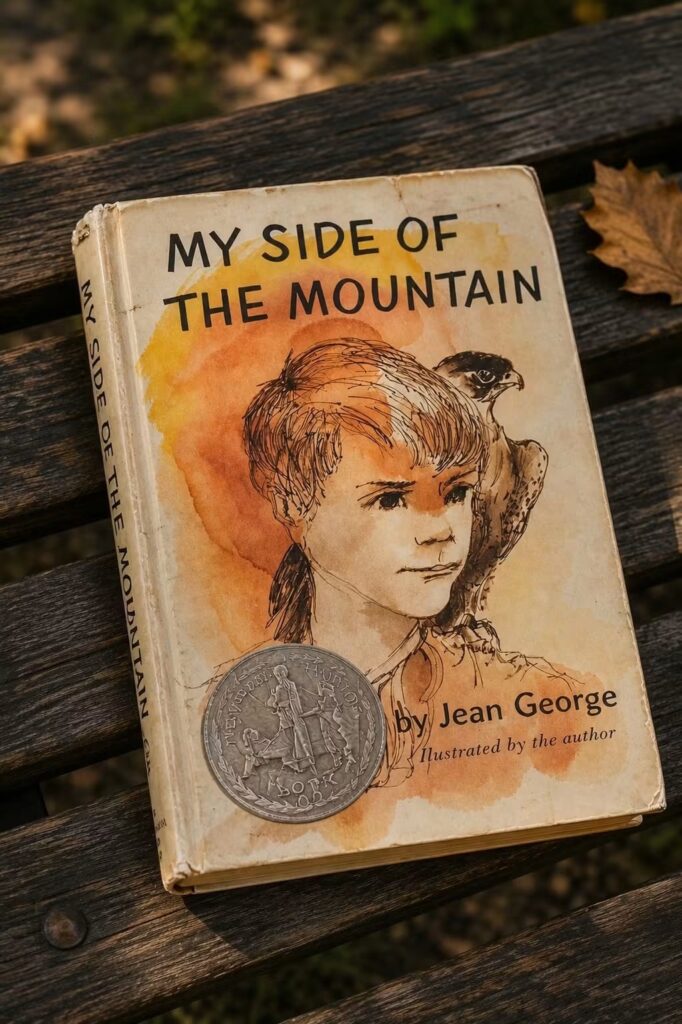
So, there is this specific feeling I have been chasing my whole reading life.
I have found it in other books since. Glimpses of it. Brief, partial, almost-but-not-quite versions of it. But I think that the first time I felt it fully – the first time a book made me understand that reading was not just something you did with your eyes but something that happened to your entire body, your entire sense of what was possible – was the first time I opened “My Side of the Mountain” by Jean Craighead George.
I was young. The exact age is not important, as I can’t even remember. What is important is that I was young enough to believe, completely and without irony, that a boy could leave New York City with forty dollars and a penknife and a piece of flint and disappear into the Catskill Mountains and not just survive but actually, genuinely, build a life there.
I believed it the way children believe things that are also true.
Sooooo, Sam Gribley lives inside a hollowed-out hemlock tree.
Let me say that again because it has never lost its power over me.
He lives. Inside a tree. A tree he found and hollowed out himself with tools he made himself in mountains he walked to alone at twelve years old. He has a falcon named Frightful who hunts with him. A weasel named The Baron who visits on his own terms. A fire. A larder dug into the earth. A bed of hemlock boughs. The specific, unhurried, completely sufficient life of someone who needed the world to be quieter than it was and went and made it so.
I read those pages and something happened to me that I do not know how to describe except to say that I became homesick for a place I had never been.
That is what this book does. It makes you homesick for the mountain. For the smell of snow coming through bark walls. For the sound of Frightful’s bells in the morning. For the feeling of being entirely alone in the world and entirely at home in it simultaneously.
I grew up in a city. I still live in a city. And somewhere in me, tucked away in the place where the things that shaped you permanently are kept, there is a hemlock tree in the Catskills that belongs to me because Jean Craighead George described it so completely when I was young enough to move in.
The National Education Association put this book on its list of the top hundred books for children. Visitors still come to a library in Delhi, New York – the real town closest to Sam’s fictional mountain – asking to see the Gribley farm. It does not exist. The wanting to see it does.
That is the measure of what Jean Craighead George built.
I reread it as an adult. I was not sure it would hold.
But it held.
Not in spite of the years between me and the child who first read it. Because of them. Because I came back to it carrying everything the years had brought – the noise and the obligation and the beautiful, exhausting accumulation of a life lived mostly indoors – and Sam Gribley was still there. Still in his hemlock tree. Still absolutely certain that this was the right life for him and only him and that the mountain had enough to give if he asked it with enough patience and enough respect.
And the feeling came back.
Not quite the same as the first time. Older. More complicated. Tinged now with the specific, adult ache of knowing that you cannot follow Sam up the mountain. That the hollowed-out hemlock is not available to you at forty-three or fifty-seven or whatever age you are returning to this book from.
But the wanting is still there.
Unchanged. As clean and as urgent as it was the first time.
This book will outlast all of us. Because every generation produces children who look at the world and find it too loud and too crowded and too fast – children who need to know that somewhere there is a hemlock tree with a fire inside it and a falcon on the branch outside and enough silence to finally hear themselves think.
This book finds those children.
It has always found them.
It found me once, too. I remember.
I enjoyed reading this book.