
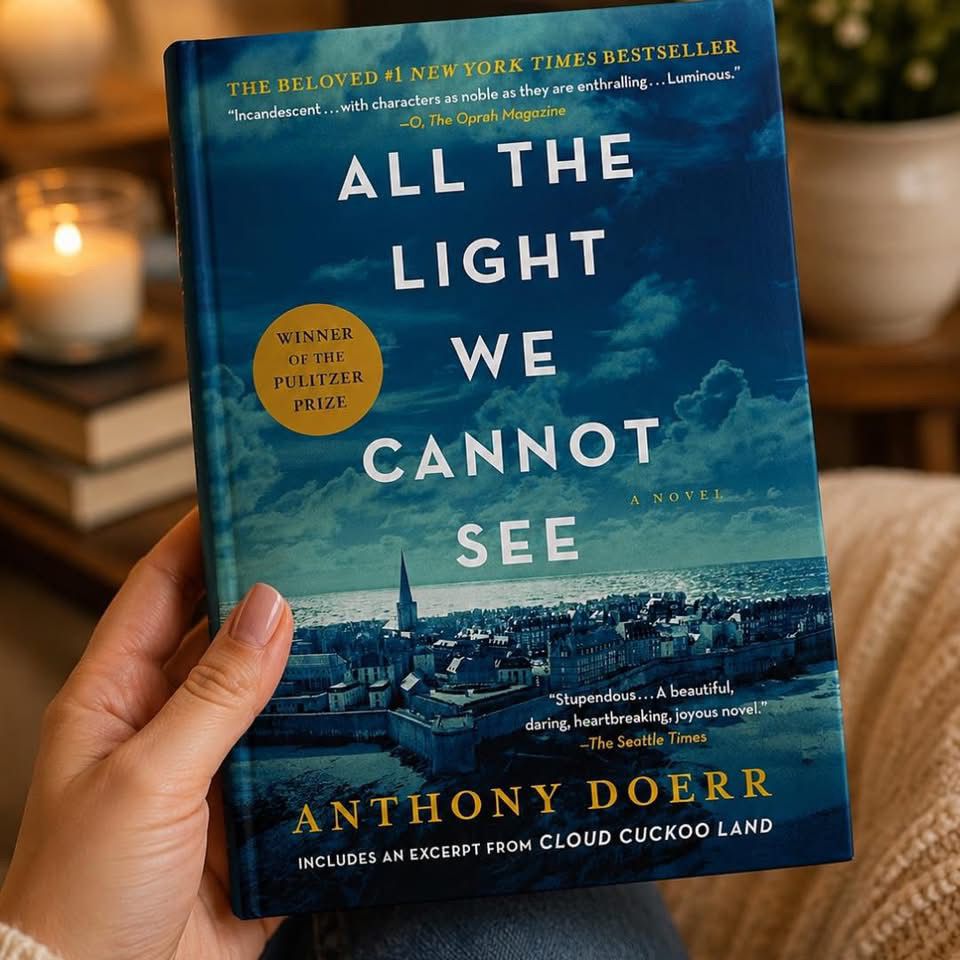
I put off reading this book for an embarrassingly long time.
Part of it was the Pulitzer Prize. I know that sounds backwards, but prize-winning novels have burned me before; I’ve picked up too many celebrated books that felt more like homework than reading, more like enduring than experiencing.
Impressive sentences in service of nothing that actually moved me. So when everyone started talking about “All the Light We Cannot See” with that particular reverence reserved for books that change people, I smiled and nodded and quietly kept my distance.
Then a friend handed me her copy and said “just start it.” So I did. At nine o’clock on a Wednesday evening, intending to read maybe forty pages before bed.
I looked up at two in the morning having read two hundred and fifty.
Anthony Doerr tells two stories that have no business being in the same novel and somehow belong nowhere else. Marie-Laure is a blind twelve-year-old girl in Paris whose father; a locksmith at the Museum of Natural History, builds her a tiny wooden model of their neighborhood so she can navigate it with her fingers, memorizing the city block by block through her hands.
Werner is a German orphan in a mining town whose extraordinary ability to repair radios catches the attention of people who will use that gift to send him somewhere he doesn’t want to go, turning him by degrees into someone he doesn’t recognize. War is coming. Their lives are being shaped by forces neither of them chose and neither of them fully understands.
Doerr moves between these two stories across time in a structure that initially made me think I’d need to keep notes. I didn’t. Within fifty pages the rhythm becomes instinctive, and the back and forth starts to feel less like a literary technique and more like breathing; one story inhaling while the other exhales, each one making the other more necessary.
Marie-Laure broke me open early and kept me open for the entire book. There’s something about a child who navigates the world through touch and sound and memory who has built an entire interior map of her life through her hands, that made me read more slowly, more carefully, as though I owed her that attention.
Doerr writes her without sentimentality and without the tragic blindness trope that lesser writers would have reached for. She’s curious and stubborn and sometimes frightened and fully, entirely herself. Watching her and her father flee Paris with almost nothing, carrying only each other and a secret neither of them fully understands, I felt something I rarely feel reading fiction, genuine protective anxiety for people who don’t exist.
Werner is the more complicated love. He’s being made into something terrible by increments so small he can almost convince himself each one doesn’t count. Doerr handles this with a precision that made me deeply uncomfortable in the best possible way; the way you’re uncomfortable when a mirror is held up and the reflection is complicated. Werner isn’t a villain. He’s a boy with a gift who gets noticed by the wrong people at the wrong moment in history, and the novel refuses to let you hate him or excuse him, which is a much harder trick than either option alone.
The writing itself is the thing that kept stopping me. Not in the way that overwrought literary prose stops you, but because Doerr keeps finding the exact image for something you thought was indescribable. There’s a passage about time being a glowing puddle you carry in your hands that I’ve thought about almost every day since I read it. He writes like someone who has paid very close attention to the world for a very long time and is quietly furious that we haven’t.
Saint-Malo, the walled coastal city where much of the novel unfolds, becomes something more than setting. The sea walls, the narrow streets, the particular quality of light over the water—Doerr makes you feel the weight of stones that have stood for centuries, and the particular obscenity of watching war arrive somewhere ancient and beautiful and wholly unprepared. I’ve never been to Saint-Malo. I feel like I’ve been to Saint-Malo.
The structure occasionally requires patience. The chapters are short, and the timeline jumps in ways that ask you to trust Doerr before he’s fully earned it. He earns it. But you have to extend that trust first, which is a real request and worth naming honestly.
By the final third I had completely abandoned any other obligation. I read with my heart somewhere in my throat, not because I was certain something terrible was going to happen, but because I had become so invested in these two people that uncertainty itself was unbearable.
I didn’t want to know and I couldn’t stop. That specific tension, dreading the end while being unable to slow down, is something only a handful of books have ever made me feel.
The ending undid me. Not because it’s tragic or triumphant but because it’s honest, because Doerr understands that war doesn’t resolve neatly, that the people shaped by impossible circumstances carry those circumstances forward into lives the war never officially touched, that light and damage travel together through time in ways that never fully separate. I sat with the last pages for a long while before closing the book.
Some novels find the places you weren’t guarding and get in quietly, and by the time you notice, it’s too late to maintain your composure.
I’m glad I finally let it in. I’m only sorry I waited so long, which is something I imagine I’ll keep being sorry about every time I think of it.
Start it in the evening if you want. Just don’t make any plans for the morning.