
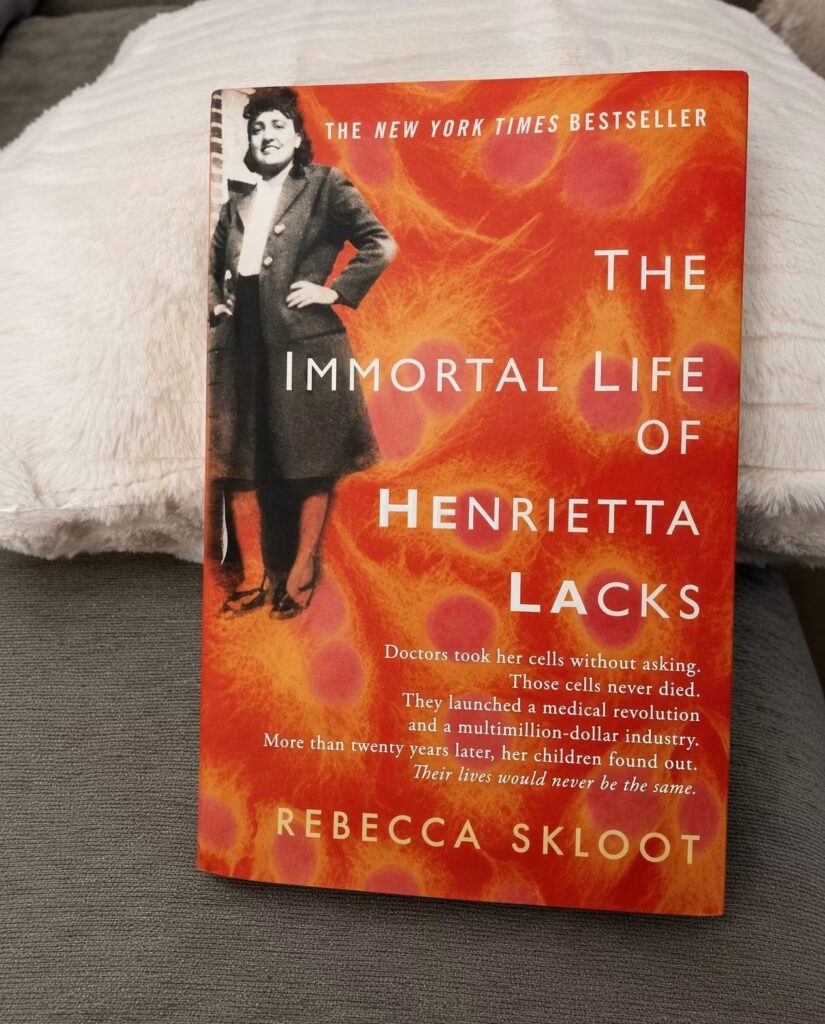
I kept having to stop reading this book because it was too much. I’d get to something so monstrous that I’d set the book face-down on my chest and stare at the ceiling for a while. And then, every single time, I’d pick it right back up. I could not stay away from it. That’s the strange power of this thing: it disturbs you and it holds you, at the exact same time, and it will not let go.
Here’s the fact that started it all, and it still makes my skin prickle. Somewhere in a lab, right now, a woman who died in 1951 is alive. Her cells are still growing, still dividing, still working – decades after she was lowered into an unmarked grave in Virginia. They’re in the polio vaccine. In cancer treatments. In IVF, gene mapping, the space program. If you gathered up every one of her cells ever grown, they’d outweigh a hundred Empire State Buildings.
Her name was Henrietta Lacks. A poor Black tobacco farmer. A mother of five. Thirty-one years old and dying of cervical cancer when a doctor at Johns Hopkins sliced a piece from her tumor without ever asking her – and changed the course of medicine forever using a woman who never once got to say yes.
And that’s where it goes from remarkable to disturbing.
Because her cells built an entire industry – sold by the vial, worth millions, saving countless lives – while her own children grew up in poverty, unable to afford the very medicine their mother’s body made possible. For over twenty years they had no idea she was “immortal.” Then scientists showed up and started taking their blood too, poking at Henrietta’s grieving kids without ever really explaining why, treating a whole family like an extension of the lab.
You read it and you feel this slow, rising heat. The casual way real human beings were used. The way race and poverty decided whose body could be taken and whose questions could be ignored. It is not a comfortable book. It’s not supposed to be. It should make you angry. It made me angry.
But here’s why it’s profound and not just upsetting. Rebecca Skloot spent ten years refusing to let Henrietta be reduced to a specimen. And the beating heart of the book is Henrietta’s daughter Deborah – who barely remembered her mother, who ached her whole life to know her, and who was terrified and heartbroken trying to understand how pieces of her mama could be frozen and bought and shot into rockets while she couldn’t even get a straight answer about who Henrietta really was.
That’s what wrecks you. Not even the science and the ethical issues. But Deborah. A daughter just wanting her mother back, in a world that remembered the cells and forgot the woman.
So yes – read it, even though parts of it will genuinely unsettle you.
Especially because they will. It’s one of the rare books that’s disturbing and unputdownable and important all at once, that changes how you see medicine and consent and whose lives we quietly decide are worth less.