
On loving The Alchemist at twenty-two, questioning it at thirty-eight, and learning that growth isn’t betrayal.
I gave The Alchemist to someone I loved when I was twenty-two, convinced it would change their life the way I was certain it had changed mine.
They handed it back three days later and said it felt like a greeting card stretched to novel length.
We broke up six months later for reasons that had nothing to do with Paulo Coelho. But I still think about that moment whenever I see the book in bookstores, spine-out and promising transformation. How certain we can be that something profound is actually just simple. How the gap between profound and simple says more about where we are in our lives than about the book itself.
That’s the thing about The Alchemist: it breaks your heart twice. Once when you first read it and believe everything it promises. And once when you read it again and realize what it can’t deliver.
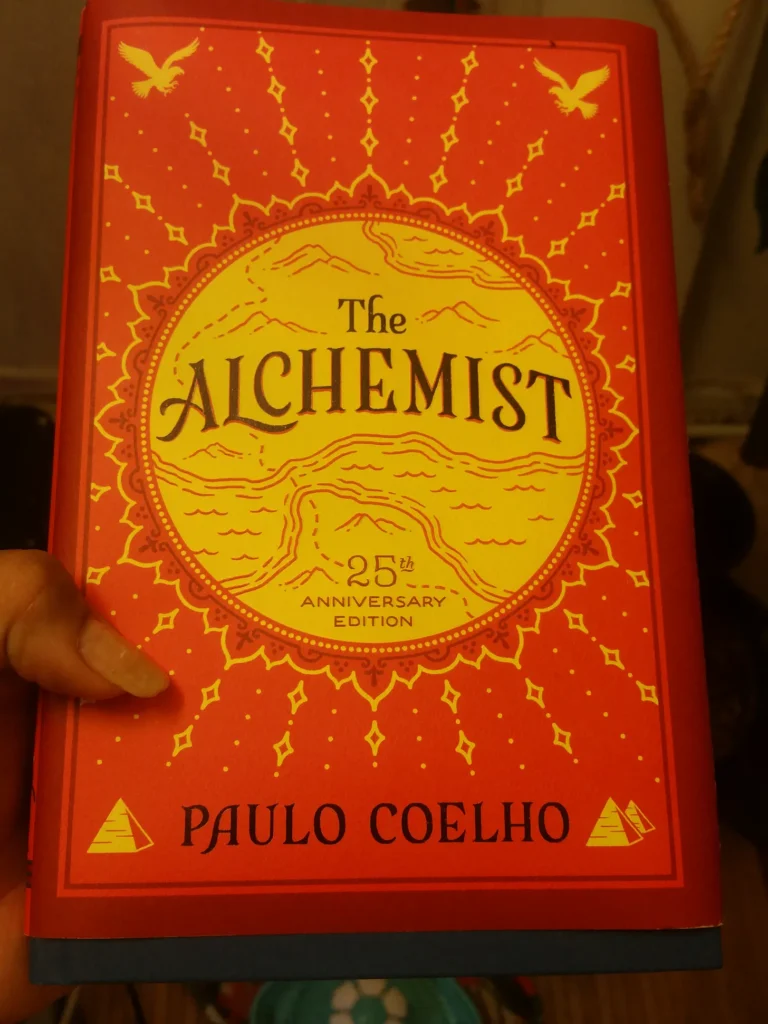
Why I’m Writing About a Book I First Read Sixteen Years Ago
I’ve been thinking a lot lately about rereading. About how the same book can be a different book depending on when you open it. How the words stay the same but you don’t, and that gap between who you were and who you’ve become is where all the interesting questions live.
We don’t owe books our loyalty. We’re allowed to outgrow them. Allowed to come back years later and discover that the thing that once felt like revelation now feels like an oversimplification. That’s not betrayal. That’s growth.
This newsletter is about that space. About the books that save us and the moment we realize they can’t save us forever. About how our perspectives shift with time, with experience, with the accumulation of dreams that didn’t work out the way Santiago’s did. About how we are allowed to question a book that once felt like scripture, to say “this helped me then, but I see its limits now.”
The Shepherd Who Sold Everything for a Dream
You probably know the story. Santiago, a shepherd boy, keeps dreaming about treasure buried near the Egyptian pyramids. Instead of ignoring this like most of us would, he sells his entire flock to chase the dream. A mysterious king tells him this is his Personal Legend, capital P, capital L, like destiny is a proper noun you can touch, and Santiago just believes him.
I’ve never been able to decide if that’s courage or just the recklessness of someone who hasn’t failed enough yet to understand fear. Maybe it’s both. Maybe courage only exists before you know better.
In the first city he reaches, Santiago gets robbed. Everything gone. Standing in Tangier unable to speak Arabic, broke and humiliated. This is where most people’s adventures would end, booking passage home, lesson learned, back to the sheep.
But Santiago gets a job at a crystal shop instead. Spends a year there learning the language, saving money, watching the merchant who’s talked about his dream of visiting Mecca for forty years without ever going.
And here’s where Coelho’s philosophy starts to take shape: you can see the judgment in those chapters. The merchant represents the life unlived, the dream deferred, the man who stayed safe. Santiago is what happens when you keep moving toward what you want, even when it costs you everything.
When I was twenty-two, this felt like truth. At thirty-eight, it feels more complicated.
You see, this book gave me the courage to quit a job that was slowly suffocating me. I read about Santiago selling his sheep and thought: if he can walk away from security, so can I. I handed in my resignation some weeks later.
I don’t regret that decision. Not for a second. That leap changed the trajectory of my entire life. The book that gave me permission to jump also taught me to trust that the universe would catch me. Only that the universe didn’t. I fell hard. Struggled for months. Learned that wanting something desperately doesn’t necessarily make it materialize, at least not immediately. That faith and courage, while necessary, aren’t sufficient.
So when I reread The Alchemist now, I hold both truths: gratitude for what it gave me then, and clear-eyed recognition of what it couldn’t prepare me for.
The Heart Knows What the Head Doesn’t (Or Does It?)
There’s an Englishman on the caravan who’s read every book about alchemy. He knows the theory, can explain the Philosopher’s Stone in technical detail. He learns nothing in the desert. Santiago, who barely reads, learns everything: by watching camels, by studying wind patterns, by understanding how silence sounds different at night.
It’s Coelho’s central argument dressed as plot: your heart knows things your head doesn’t. Trust feelings over facts. Wisdom lives in experience, not study. And depending on where you are in your life, that idea either resonates deeply or sounds like permission to stop doing the hard work of thinking.
I believed it completely at twenty-two. I’m not sure what I believe now.
Because I’ve watched what happens when people follow their hearts off cliffs. When intuition leads somewhere dark and they’re too committed to the journey to admit they made a wrong turn. When faith becomes stubbornness and stubbornness becomes ruin.
The Woman Who Waits
Fatima appears at the oasis. She’s beautiful and patient and tells Santiago to leave her and finish his journey because true love doesn’t cage people. Which sounds enlightened until you notice: she doesn’t get her own journey. Doesn’t get her own Personal Legend. She waits at the oasis like a prize Santiago can collect later.
I want to be generous here. Coelho published this in 1988 in Brazil. Different time. Different context. And maybe Fatima’s waiting is meant to be her own form of strength.
But I can’t quite make that work in 2026. Because the book is so insistent that everyone has a Personal Legend, that pursuing your dreams is sacred, and yet Fatima’s purpose is entirely defined by enabling Santiago’s plot. Coelho thinks he’s writing about love that liberates. But I think he’s actually written a woman whose entire purpose is to enable a man’s story
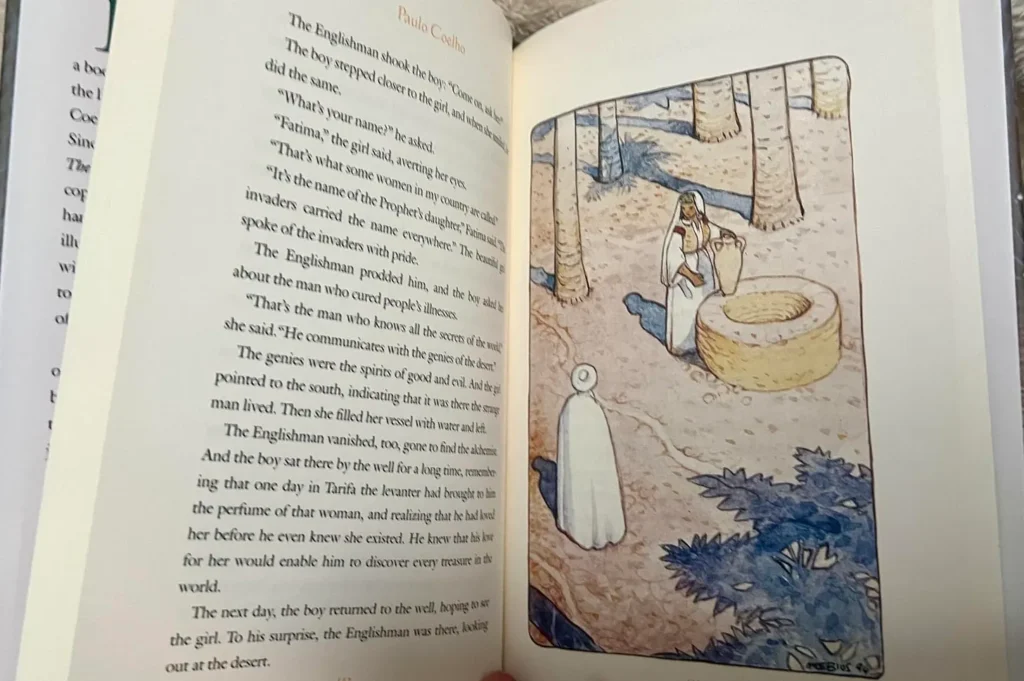
The Treasure That Was Home All Along
At the pyramids, Santiago digs where his dream said to dig and finds nothing. Gets beaten by refugees. And one of them mentions having a dream about a treasure buried in Spain under a sycamore tree where a shepherd sleeps. Santiago’s tree. The treasure was home the entire time.
He traveled across a continent to learn he should have stayed put. Except he wouldn’t have known where to dig if he hadn’t left. You must leave to return. Must lose to find. Must travel to discover home.
When I first read this, I thought it was the most beautiful thing I’d ever encountered. The perfect symmetry of it. The way the journey itself was the point, not the destination.
Reading it now, it feels like circular logic dressed as profundity. Like Coelho is protecting himself from being wrong, if you find the treasure, the journey worked; if you don’t, the journey itself was the treasure. Either way, he’s right. Or maybe it’s just a way of making every outcome feel meaningful, even when the outcome is discovering you wasted years chasing something that was already yours.
The Universe Doesn’t Always Conspire
Coelho published this in Portuguese in 1988. It barely sold. Then a French publisher took a chance, and now it’s moved over 150 million copies worldwide.
That success has become part of the book’s mythology, proof that if you follow your Personal Legend, the universe conspires to help you. But thousands of writers follow their dreams and die broke and unpublished. Coelho’s success might be luck and timing, not cosmic affirmation.
The book can’t admit that, though. Because luck destroys the entire premise.
I know people who’ve called this book life-changing, and they mean it genuinely. I’ve met travelers who quit corporate jobs after reading it, sold everything to backpack through South America, moved to Bali to find themselves. Some found what they were looking for. Some came back confused and broke, wondering why the universe didn’t hold up its end of the bargain.
The book promises that wanting something badly enough makes the universe bend toward you. And that’s either inspiration or delusion, depending on how many times you’ve wanted something desperately and gotten nothing.
A Note To Readers
I don’t think this book is a lie. I think it’s a partial truth. And partial truths are the most seductive kind because they feel true enough to believe entirely.
Sometimes, when you commit to something you want, doors do open. Opportunities do appear. The world does seem to conspire in your favor, not because of magic, but because you’re paying attention differently. Because you’re saying yes to things you would have dismissed before. Because clarity about what you want makes you braver about pursuing it.
But sometimes it doesn’t work that way. Sometimes you follow your heart with complete commitment and still end up broke and confused. Sometimes omens mislead. Sometimes the dream you’re chasing isn’t your Personal Legend, it’s just a dream, and pursuing it will cost you everything for nothing.
The danger is when we take Coelho’s mysticism as a guarantee rather than a possibility. When we abandon critical thinking entirely in favor of just feeling and trusting and moving.
Because sometimes your heart is right and your head is holding you back from necessary risk. And sometimes your heart is wrong and your head is trying to save you from unnecessary harm. The wisdom is knowing which is which. And Coelho doesn’t really help with that, does he?
Why I Still Keep This Book
Despite all my questions, I haven’t thrown away my copy of The Alchemist. It’s on my shelf, spine cracked from multiple readings, margins full of notes from different versions of myself.
Because here’s what the book gets right: most of us are living smaller lives than we need to. Most of us have dreams we’ve abandoned not because they were impossible but because pursuing them was inconvenient. Most of us are the crystal merchant, talking about Mecca but never going, choosing safety over the slim possibility of something more.
And sometimes we need a book that says: go. Try. Risk. The world won’t end if you fail, but something in you will die if you never try
What I know is this: The Alchemist is the book I needed at twenty-two and the book I question at thirty-eight. And both of those truths can coexist. The book that opens your world can also be the book you eventually see the edges of. And that’s not betrayal. That’s just what happens when you keep growing.
We need different books at different times. And sometimes the books that change us are the ones we eventually see more clearly. That doesn’t make them less valuable. It just makes them what they always were: not perfect truth, but a mirror. Showing us who we are and who we’re trying to become.
Thanks for reading, friends. I’d love to hear your thoughts—Have you read The Alchemist? Did it change you? Did you reread it and find it different? What books have you reread and discovered you’d outgrown?
I’d love to hear your stories. Reply to this email, or to the article on the app. Tell me about the book that promised you everything and what it delivered instead.
I will leave the light on for you! 📚✨